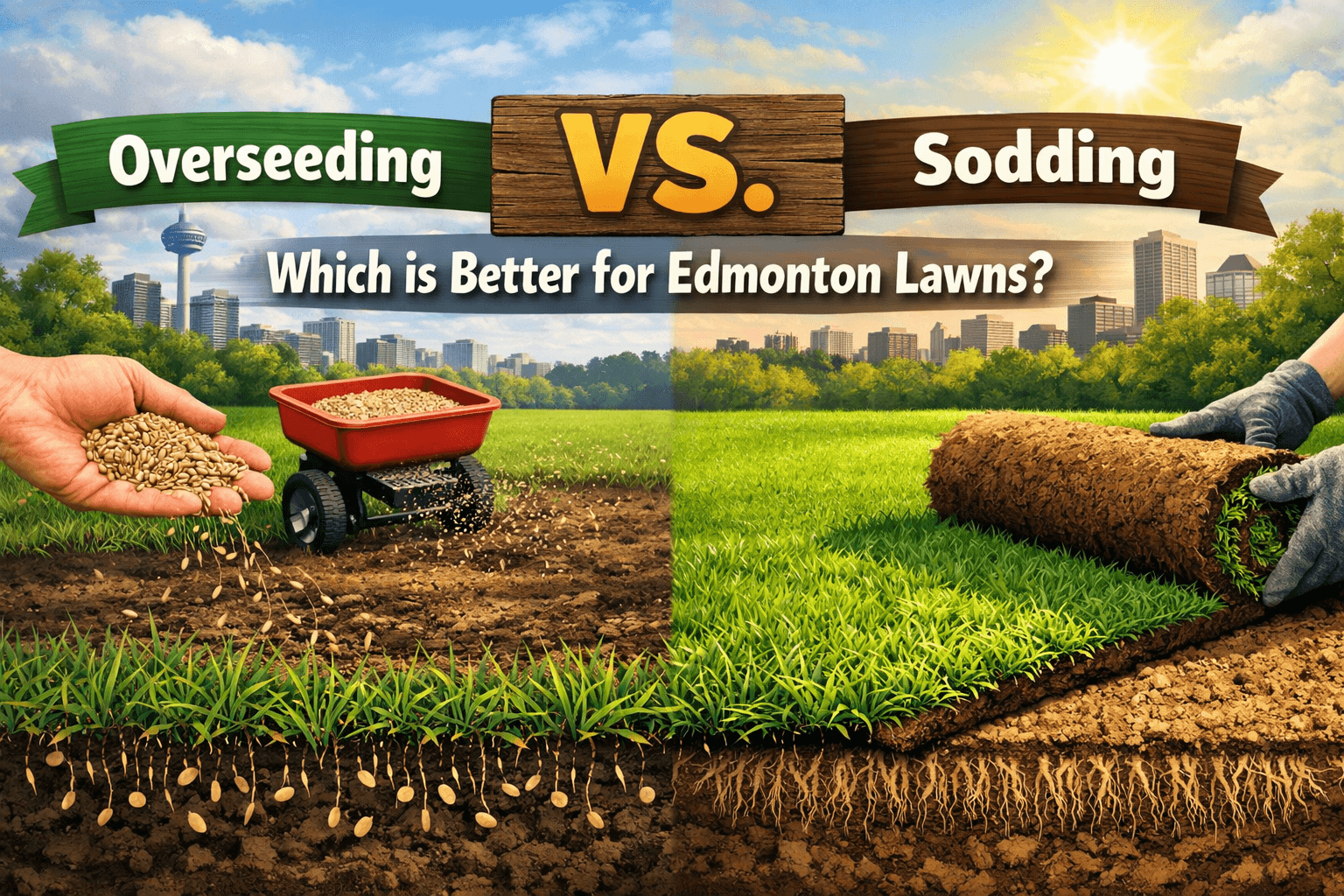
Every spring, Edmonton homeowners face the same dilemma. After months of snow, ice, and freeze-thaw cycles, parts of the lawn look thin, bare, or completely dead — and the question becomes: do you overseed, or do you lay new sod?
Both options can restore a damaged or struggling lawn. But they work differently, cost differently, and suit different situations. Choosing the wrong one for your specific lawn — or your specific timeline — can mean wasted money, disappointing results, or a lawn that looks worse before it looks better.
This guide breaks down everything you need to know about overseeding vs. sodding in Edmonton — the pros, the cons, the costs, and the situations where one clearly wins over the other.
What Is Overseeding?
Overseeding is the process of spreading new grass seed directly over your existing lawn — without removing the current turf. It is used to fill in thin or bare patches, thicken a lawn that has become sparse over time, or introduce a more resilient grass variety into an established yard.
When done correctly, overseeding works with the existing lawn rather than replacing it. The new seeds germinate between existing grass plants, gradually filling in the gaps and creating a denser, more uniform turf over time. For best results in Edmonton, overseeding is paired with deep core aeration — the holes left by the aerator give seeds direct soil contact, dramatically improving germination rates.
What Is Sodding?
Sodding — also called turfing — involves laying rolls or squares of pre-grown grass directly onto prepared soil. The sod comes with an established root system already in place, giving you an instant lawn the day it is installed.
Sodding is typically used when large sections of a lawn have died completely, when a new lawn is being established from scratch, or when a homeowner needs a finished-looking yard quickly — for a home sale, landscaping project, or event. It requires more preparation and investment upfront, but delivers immediate visual results.
Overseeding in Edmonton: Pros and Cons
Advantages of Overseeding:
- Significantly more affordable than sodding — especially for large areas
- Works with your existing lawn rather than disrupting it
- Allows you to introduce drought-resistant or cold-hardy grass varieties suited to Alberta
- Paired with aeration, results in a thicker, more resilient lawn over the full season
- Low disruption — no soil removal, no heavy equipment on the property
- Ideal for lawns with scattered thin patches rather than complete failure
Disadvantages of Overseeding:
- Results take time — full establishment typically takes four to eight weeks
- Seeds need consistent moisture during germination — requires regular watering
- Not effective on completely dead or heavily compacted bare areas without soil prep
- Edmonton’s short growing season creates a narrow ideal window for seeding
- New seedlings are vulnerable to foot traffic until fully established
Sodding in Edmonton: Pros and Cons
Advantages of Sodding:
- Instant results — your lawn looks finished and green the day it is laid
- No germination window to worry about — less timing pressure than seeding
- Effective for completely bare or dead areas that need full replacement
- Establishes a weed-competitive turf much faster than seeding
- Reduces erosion risk on slopes or areas with loose soil
- Great option when a property needs to look its best quickly
Disadvantages of Sodding:
- Significantly more expensive than overseeding — often four to ten times the cost
- Requires thorough soil preparation before installation for roots to take hold
- Still needs careful watering and restricted foot traffic for the first two to three weeks
- Sod must be installed quickly after delivery — it deteriorates within 24 to 48 hours
- Limited grass variety selection compared to seeding options
- In Edmonton, installation must be timed carefully to avoid late frosts
Overseeding vs. Sodding: Quick Comparison for Edmonton
| Factor | Overseeding | Sodding |
| Cost | Low to moderate | High |
| Time to results | 4 to 8 weeks | Immediate |
| Best for | Thin or patchy lawns | Large dead or bare areas |
| Soil disruption | Minimal | Significant prep needed |
| Grass variety choice | Wide selection | Limited |
| Watering commitment | High (germination) | High (establishment) |
| Foot traffic restriction | 4 to 6 weeks | 2 to 3 weeks |
| Edmonton timing | Late April to mid-May | May to early September |
| Long-term soil health | Improves with aeration | Depends on prep |
The Edmonton Factor: How Our Climate Affects the Decision
Edmonton’s climate adds a layer of complexity to this decision that homeowners in warmer cities simply do not have to think about.
Short Growing Season:
Edmonton typically sees its last frost around mid-May and its first fall frost as early as mid-September. That gives you roughly 16 to 18 weeks of safe growing season. For overseeding, grass seed needs at least six to eight weeks of warm soil to germinate and establish properly before fall arrives. This means the window for spring overseeding is roughly late April through the end of May — after the soil has thawed but early enough that seedlings have time to establish.
Clay-Heavy Soil:
Edmonton’s soil is predominantly clay-based, which compacts easily and drains poorly. For overseeding, this is why aeration is not optional — it is essential. For sodding, it means soil preparation requires more work than in areas with sandy or loamy soil. Without proper soil prep, even expensive sod can fail to root properly.
Winter Hardiness:
One advantage of overseeding is the ability to choose grass seed varieties that are specifically bred for cold climates. Kentucky bluegrass and fine fescue blends are popular in Edmonton because they handle Alberta winters better than many sod varieties available locally. If winter hardiness is a priority, overseeding with the right seed mix gives you more control over the long-term resilience of your lawn.
So — Which One Should You Choose?
The right answer depends on what your lawn actually needs. Here is a straightforward guide:
Choose overseeding if:
- Your lawn has thin, patchy, or sparse areas but is not completely dead
- You want to improve the overall density and resilience of your turf over a season
- Budget is a consideration and you have time to wait for results
- You want to introduce a more cold-hardy or drought-resistant grass variety
- The damaged area is less than roughly 40 to 50 percent of the total lawn
Choose sodding if:
- Large sections of your lawn are completely dead and bare
- You need the lawn to look finished quickly — for a sale, renovation, or event
- The lawn is being fully replaced or newly established after construction
- You are dealing with significant erosion on a slope that seed alone cannot hold
- More than half the lawn has failed and starting fresh makes more sense
Not Sure What Your Lawn Needs? Seasons 360 Can Help.
Sometimes it is genuinely hard to tell whether overseeding or sodding is the right call — especially when different parts of your lawn have different levels of damage. That is exactly the kind of situation where a professional assessment makes a real difference.
At Seasons 360, we have worked on lawns across Edmonton in all conditions — from minor post-winter patchiness to complete turf failures. We know how to read a lawn, identify the underlying causes of damage, and recommend the most cost-effective solution that actually lasts. Whether your lawn needs overseeding paired with aeration, targeted sodding, or a combination of both, we will give you an honest recommendation and handle the work from start to finish.
Contact Seasons 360 today for a free quote and let us help you get the right result for your Edmonton lawn this spring.