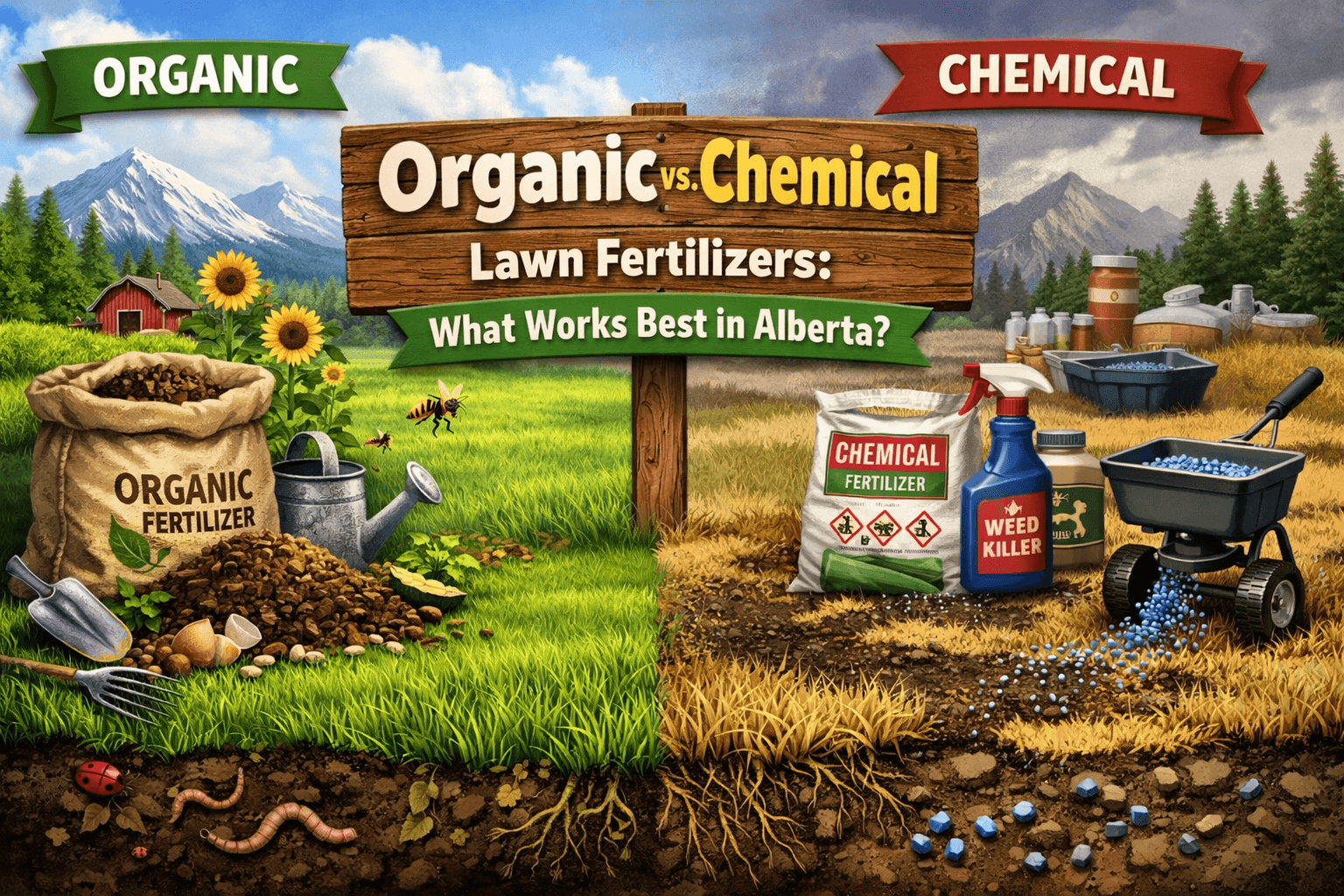
If you have ever stood in the lawn care aisle at a garden centre staring at a wall of fertilizer bags — not quite sure which one to choose — you are not alone. The organic vs. chemical fertilizer debate is one of the most common questions Alberta homeowners ask when it comes to lawn care.
Both types of fertilizer can help your lawn grow greener and healthier. But they work in very different ways, at different speeds, and with different outcomes — especially in a climate like Alberta’s, where the growing season is short, winters are severe, and the soil comes with its own unique challenges.
At Seasons 360, we fertilize lawns across Edmonton every season and have seen firsthand what works, what does not, and why the answer is often more nuanced than simply picking a side. Here is an honest, practical breakdown to help you make the right choice for your lawn.
First, What Does Lawn Fertilizer Actually Do?
Whether organic or chemical, all lawn fertilizers deliver three core nutrients that grass needs to grow: nitrogen (N), phosphorus (P), and potassium (K). You will see these listed as three numbers on every fertilizer bag — for example, 24-0-10 — which represent the percentage of each nutrient in that product.
- Nitrogen (N) — drives green colour and blade growth
- Phosphorus (P) — supports root development and establishment
- Potassium (K) — builds overall resilience, stress tolerance, and winter hardiness
The difference between organic and chemical fertilizers is not what nutrients they deliver — it is how those nutrients are delivered and how quickly the lawn can use them.
Chemical (Synthetic) Fertilizers: Fast Results, Precise Control
Chemical fertilizers are manufactured products that deliver nutrients in a form grass can absorb almost immediately. They are highly concentrated, precisely formulated, and designed for fast, visible results.
Advantages of Chemical Fertilizers:
- Fast-acting — you can see greening within days of application
- Precise nutrient ratios — easy to target specific deficiencies
- Cost-effective for large lawns
- Widely available and easy to apply
- Ideal for lawns in recovery or under stress that need immediate feeding
Disadvantages of Chemical Fertilizers:
- Risk of burning the lawn if over-applied or applied to dry grass
- Nutrients absorb quickly but do not last — frequent reapplication needed
- Can leach into groundwater if applied before heavy rain
- Does not improve soil health over time — grass becomes dependent on repeated treatments
- Can disrupt the natural microbial activity in the soil
In Alberta’s short growing season, the speed of chemical fertilizers can be a real advantage — especially in spring when you need the lawn to recover quickly after a long winter. However, the trade-off is that you are feeding the grass, not the soil, which creates a cycle of dependency over time.
Organic Fertilizers: Slower but Smarter for the Long Term
Organic fertilizers are derived from natural materials — things like composted manure, bone meal, kelp, blood meal, and feather meal. Rather than delivering nutrients directly to the grass, they feed the soil microbes that break down organic matter and release nutrients gradually over time.
Advantages of Organic Fertilizers:
- Improves soil structure and microbial health over time
- Slow-release nutrients reduce the risk of burning
- Builds long-term lawn resilience — less reliance on repeated treatments
- More environmentally friendly and safer for pets, children, and water systems
- Helps break up Alberta’s clay-heavy soil over multiple seasons
Disadvantages of Organic Fertilizers:
- Slow to show results — may take several weeks to visibly green up the lawn
- Lower nutrient concentration means you need more product to cover the same area
- Effectiveness depends on soil temperature — microbes are less active in cold ground
- More expensive per application in many cases
- Less reliable for lawns that need urgent recovery after severe winter damage
The slow-release nature of organic fertilizers is actually well-suited to Alberta’s growing season in theory — but there is a practical challenge. Organic fertilizers rely on soil microbes to activate, and those microbes are significantly less active in cold soil. Since Edmonton’s spring soil stays cold well into May, organic fertilizers applied too early can sit in the ground doing very little for weeks.
Side-by-Side Comparison for Alberta Lawns
Here is a quick comparison of how both fertilizer types perform in Alberta’s specific conditions:
| Factor | Chemical Fertilizer | Organic Fertilizer |
| Speed of results | Fast (days) | Slow (weeks) |
| Burn risk | Higher | Very low |
| Soil health improvement | None | Significant over time |
| Cold soil performance | Works in cool soil | Less effective below 10C |
| Environmental impact | Higher risk of runoff | Lower impact |
| Best for spring recovery | Yes | Not ideal |
| Best for long-term health | No | Yes |
| Cost per application | Lower | Higher |
What Actually Works Best for Alberta Lawns?
Here is the honest answer: neither option alone is the perfect solution for Alberta’s climate. The best results come from a strategic combination of both — using the right type at the right time of year.
Spring (Late April to May):
Use a slow-release synthetic fertilizer in early spring. At this time of year, the soil is still too cold for organic fertilizers to activate effectively, but your lawn is coming out of dormancy and needs a nutritional boost to recover. A slow-release chemical formula provides the nitrogen your grass needs without the burn risk of a fast-release product on stressed turf.
Summer (June to August):
Once the soil has warmed up and the lawn is actively growing, organic or blended fertilizers become much more effective. This is when the soil microbes responsible for breaking down organic nutrients are most active. Regular light applications through summer maintain the lawn without risk of heat stress or burning.
Fall (September to October):
A fall fertilization with higher potassium content is one of the most important and most overlooked steps for Alberta lawns. Potassium strengthens the grass cell walls, improves winter hardiness, and helps the lawn store the energy it needs to survive Edmonton’s long cold season. This single application can make a significant difference in how your lawn looks the following spring.
A Note on Fertilizer Regulations in Alberta
Alberta does not currently have the same municipal restrictions on fertilizer use that some other Canadian provinces have, but responsible application still matters — particularly in areas near water features, storm drains, and natural drainage paths. Over-applying fertilizer, especially before heavy rain, can contribute to nutrient runoff that affects local waterways.
Professional application by a knowledgeable lawn care company ensures that the right product is applied at the right rate, at the right time — minimizing waste, reducing environmental impact, and maximizing the benefit to your lawn.
Let Seasons 360 Handle Your Lawn Fertilization in Edmonton
Choosing the right fertilizer is only part of the equation. Knowing when to apply it, how much to use, and how to combine it with aeration and other spring treatments is what separates a lawn that greens up nicely from one that truly thrives all season long.
At Seasons 360, our lawn fertilization service is built around Edmonton’s specific climate, soil conditions, and growing season. We use the right products at the right times so every application delivers real, visible results — without the risk of burning, wasting product, or missing the optimal window.
Contact Seasons 360 today for a free quote and let us put together the right fertilization plan for your Edmonton lawn.