If you have ever looked out at your Edmonton lawn in spring and wondered where all the weeds came from seemingly overnight, you are not imagining things. Weeds are opportunists — they are always there, waiting for the right conditions to emerge. And Edmonton’s spring environment gives them exactly what they need: freshly thawed soil, lots of moisture, and a lawn that is still recovering from months of winter stress and not yet strong enough to compete.
The frustrating reality is that weeds grow faster, establish more aggressively, and are far harder to remove than the grass you actually want. But understanding which weeds you are dealing with, why they appear, and what actually eliminates them — rather than just knocking them back temporarily — is the first step toward a lawn where grass wins and weeds lose.
Here is a practical guide to the most common lawn weeds in Edmonton, along with exactly what you need to do to get rid of each one for good.
Why Edmonton Lawns Are Especially Vulnerable to Weeds
Before identifying specific weeds, it is worth understanding why Edmonton lawns tend to struggle with weed pressure more than lawns in milder climates. The answer comes down to the combination of a short growing season, heavy clay soil, and the annual winter damage cycle. Every spring, Edmonton grass comes out of dormancy weakened and thin — and thin grass is exactly the environment where weeds thrive.
Weeds are not inherently stronger than grass — they are simply better adapted to the conditions that stressed lawns create. Bare patches, compacted soil, low fertility, and poor drainage all give weeds the foothold they need to establish before the grass can recover. This is why weed control alone is rarely a long-term solution. Eliminating the conditions that favour weeds — through aeration, fertilization, and proper lawn maintenance — is what keeps them from coming back season after season.
Dandelion (Taraxacum officinale)
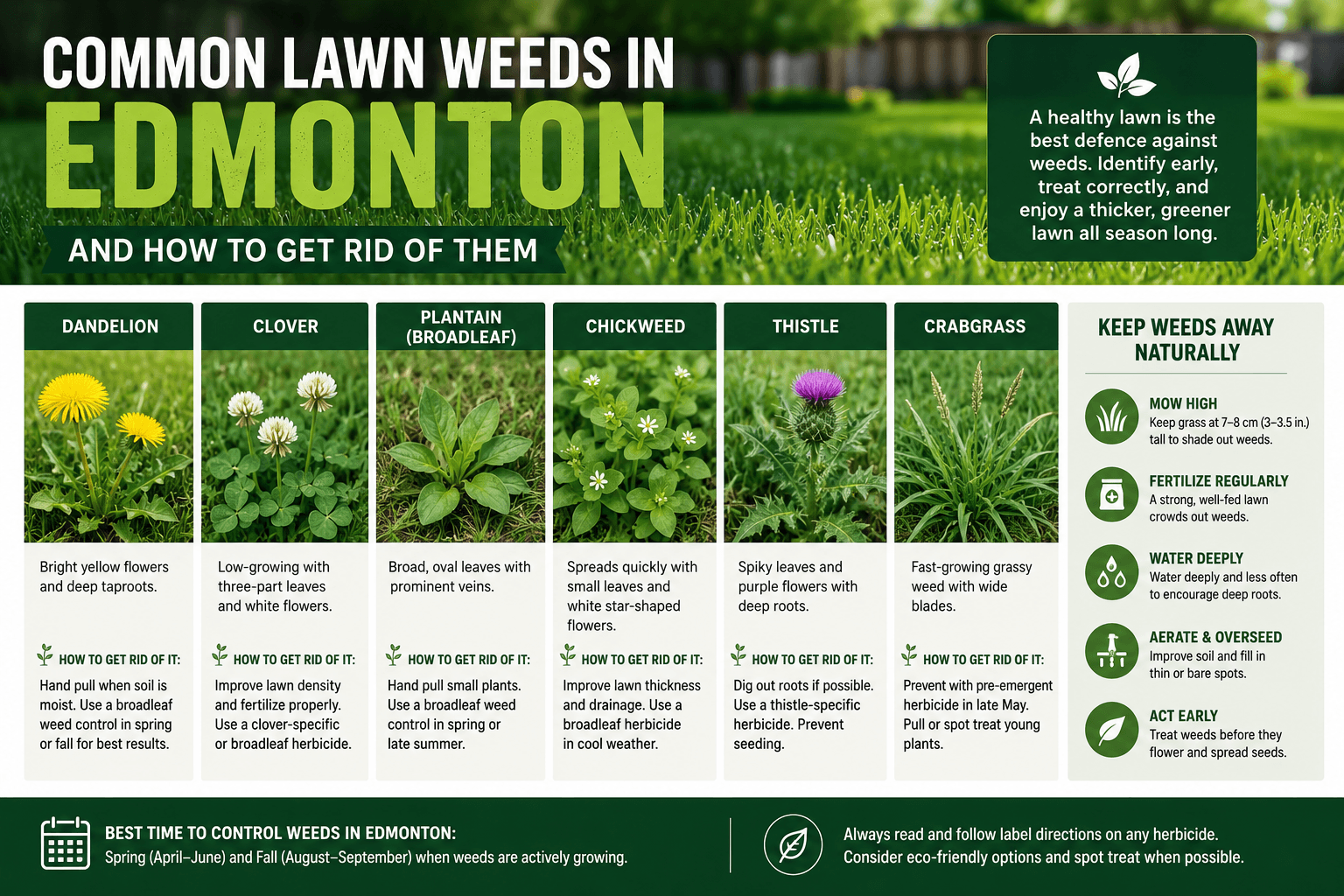
Dandelions are by far the most recognizable and most common lawn weed in Edmonton. Their bright yellow flowers appear almost as soon as the snow melts, and their ability to spread is extraordinary — a single dandelion plant can produce up to 15,000 seeds per season, each one carried by the wind to new locations across your lawn and your neighbours’ lawns.
The real challenge with dandelions is their root system. The taproot can extend up to a foot deep into the soil, and any piece of root left behind after manual removal will regenerate a new plant. This is why hand-pulling dandelions rarely provides lasting results — unless the entire root is removed cleanly, which is extremely difficult in Edmonton’s clay soil.
How to Get Rid of Dandelions:
The most effective approach combines professional broadleaf weed control applied in late spring — before dandelions fully flower and seed — with a strong lawn fertilization program that thickens the surrounding grass so dandelions have less space to establish. Targeted spot treatments can address isolated plants through the season. The key is consistency — one weed control treatment per year is rarely sufficient for Edmonton lawns with established dandelion pressure.
Creeping Charlie (Glechoma hederacea)
Creeping charlie is one of the most invasive and difficult-to-control weeds in Edmonton residential lawns. Unlike dandelions which grow upright, creeping charlie spreads horizontally across the soil surface, sending out long stems called stolons that root at each node wherever they touch the ground. Once established, it can cover large areas of a lawn very quickly and crowd out grass entirely in shaded or moist sections of the yard.
It is identifiable by its small, scalloped round leaves, square stems, and small purple flowers that appear in late spring. It thrives particularly well in areas with poor drainage, shade, and compacted soil — all common conditions in Edmonton yards, especially near fences, tree lines, and north-facing sections of the lawn.
How to Get Rid of Creeping Charlie:
Creeping charlie requires a selective broadleaf herbicide applied when the plant is actively growing in spring or early fall. Multiple applications are often needed to fully eliminate an established patch. Improving drainage, aerating compacted areas, and overseeding with shade-tolerant grass varieties reduces the conditions that allow creeping charlie to return after treatment. Manual removal is ineffective for large infestations because any fragment of stem left in the soil can regenerate.
Canada Thistle (Cirsium arvense)
Canada thistle is a persistent perennial weed that is particularly common in Edmonton lawns bordering alleys, undeveloped land, or areas with disturbed soil. It is recognizable by its spiny, lobed leaves and purple flower heads, and it spreads both by seed and through an extensive underground root system that can extend several metres horizontally.
What makes Canada thistle especially problematic is its root system. Even after the visible plant is removed or killed at the surface, the underground roots remain alive and will push up new shoots from multiple points. A single thistle plant can regenerate into a large patch within a single season if the root system is not fully addressed.
How to Get Rid of Canada Thistle:
Selective herbicide applied directly to actively growing thistle plants — ideally in late spring or early fall when the plant is moving nutrients to its roots — is the most effective treatment. Persistence is essential because the root system typically survives the first one or two applications and sends up new growth. Consistent treatment over one to two seasons is usually required to fully exhaust the root system and eliminate the plant.
Crabgrass (Digitaria spp.)
Crabgrass is an annual grassy weed that germinates from seed each spring when soil temperatures warm above ten degrees Celsius — which in Edmonton typically happens in late May or early June. It grows in a low, spreading pattern with wide, flat blades that look noticeably different from the finer texture of desirable lawn grasses, and it tends to appear in bare, thin, or high-traffic areas where the soil warms quickly.
Because crabgrass is an annual, it dies at the end of each growing season — but not before producing thousands of seeds that sit in the soil over winter, ready to germinate again the following spring. A lawn that has crabgrass in one summer will almost certainly have it again the following year unless the seed is prevented from germinating.
How to Get Rid of Crabgrass:
Pre-emergent herbicide applied in spring before soil temperatures reach the germination threshold prevents crabgrass seeds from sprouting. Once crabgrass is already growing, post-emergent treatments can eliminate it, but they are less effective on mature plants. The longer-term solution is to thicken the lawn through overseeding, aeration, and fertilization so that dense grass covers the bare areas where crabgrass seeds germinate most readily.
Clover (Trifolium repens)
White clover is a low-growing perennial weed that spreads through both seeds and creeping stems. It is identifiable by its distinctive three-leaf clusters and small white flower heads that attract bees in summer. Clover is particularly common in Edmonton lawns that are low in nitrogen — because unlike grass, clover can fix its own nitrogen from the atmosphere, giving it a strong competitive advantage in nutrient-poor soil.
The presence of clover in a lawn is often a clear indicator that the soil is undernourished and that the fertilization program needs attention. Simply treating the clover without addressing the underlying nitrogen deficiency tends to produce only temporary results, because the conditions that allowed clover to outcompete the grass in the first place remain unchanged.
How to Get Rid of Clover:
A broadleaf herbicide applied in spring or early summer targets clover effectively. But the more important step is improving the lawn’s nitrogen levels through a proper fertilization program, which removes the competitive advantage that clover depends on. A well-fed, dense lawn will naturally suppress clover far more effectively than any herbicide treatment used in isolation.
The Real Solution: A Healthy Lawn That Wins on Its Own
Every weed on this list has one thing in common: it thrives in conditions that stressed, thin, or nutrient-deficient grass creates. Weed control treatments are an essential part of the solution, but they are most effective — and most lasting — when they are part of a broader lawn care program that addresses the root causes of weed pressure.
At Seasons 360, our weed control service is always paired with aeration, fertilization, and overseeding recommendations because we know from experience that a thick, healthy, well-nourished lawn is the most effective weed suppression system available. When grass is dense and actively growing, weeds simply run out of the light, space, and resources they need to establish.
Contact Seasons 360 Ltd. today for a free quote on our weed control and lawn care services in Edmonton. Let us identify what is growing in your lawn and put together the right plan to eliminate it for good.