Every Edmonton homeowner wants the same thing: a thick, lush, green lawn that looks good all season and holds up through whatever Alberta’s weather throws at it. But most homeowners also know that kind of lawn does not happen by accident — and it rarely happens from watering and mowing alone.
The difference between a lawn that looks average and one that genuinely stands out on the street comes down to a specific set of treatments done in the right order. Skip one step and the results suffer. Do them out of sequence and you waste time, money, and product. But when they are all done correctly, the transformation is remarkable — and it happens faster than most people expect.
At Seasons 360, we have helped hundreds of Edmonton homeowners achieve exactly this kind of lawn. This guide walks you through every step of the process — from clearing the damage of winter all the way through to maintaining the results across the growing season. Follow this sequence and your lawn will look like a different property by mid-summer.
Why Edmonton Lawns Struggle to Stay Thick and Green
Before getting into the steps, it helps to understand why Edmonton lawns face challenges that lawns in warmer Canadian cities simply do not deal with to the same degree. The combination of a short growing season, severe winters, repeated freeze-thaw cycles, and the city’s heavy clay soil creates a set of conditions that actively work against a healthy lawn unless you consistently intervene.
Clay soil compacts under winter pressure, blocking water and nutrients from reaching the roots. Thatch builds up faster than it can decompose in cold temperatures. Nitrogen — the nutrient most responsible for green colour — depletes significantly over winter and washes away with spring snowmelt before the grass can absorb it. Weeds emerge aggressively in spring and compete directly with recovering grass for space, light, and nutrients.
A thick, green Edmonton lawn is achievable — but it requires addressing all of these factors together, not just one or two of them. That is exactly what the following steps are designed to do.
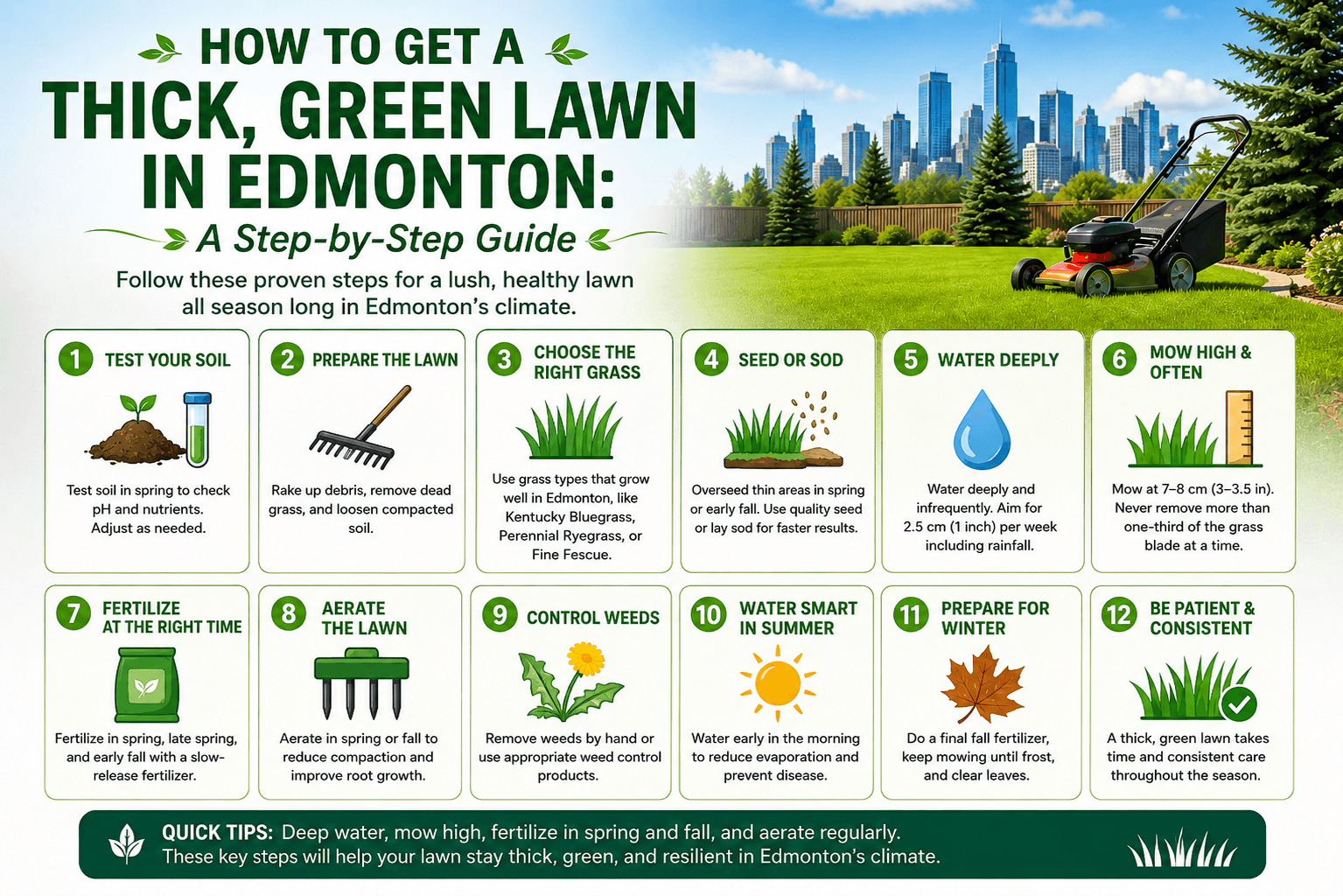
Step 1: Start with a Professional Spring Cleanup
A thick lawn starts with a clean slate. After Edmonton’s winter, your lawn is buried under a layer of dead leaves, debris, matted grass, and salt deposits from driveways and sidewalks. This material does not disappear on its own — it sits on the surface blocking sunlight and trapping moisture, which creates the perfect environment for fungal disease and prevents new growth from pushing through.
A thorough spring cleanup removes all of this — debris, dead material, salt residue, and the remnants of winter. It sounds basic, but it is genuinely foundational. Every other treatment you do after this point will perform better on a clean, clear lawn than on one still buried under winter’s leftovers. Think of spring cleanup as clearing the runway before a plane takes off. Without it, nothing else works as well.
Step 2: Power Rake to Let the Lawn Breathe Again
Once the surface debris is cleared, the next obstacle to a thick lawn is thatch — the dense layer of dead grass stems, roots, and organic matter that accumulates just above the soil surface. Thatch is one of the most underestimated enemies of a healthy Edmonton lawn. When it builds up beyond half an inch, it acts as a physical barrier that prevents water, fertilizer, and oxygen from penetrating to the root zone where they are actually needed.
Power raking uses a specialized machine with rotating tines to strip this thatch layer away aggressively and efficiently. It is significantly more effective than hand raking, and for Edmonton lawns coming out of a long winter, it is one of the most visually impactful treatments you can do. Within days of a good power rake, the lawn starts looking noticeably better because the grass can suddenly breathe, absorb light, and push up new growth without fighting through a layer of dead material.
Power raking should always happen after spring cleanup and before aeration. Done in this order, each step prepares the lawn for the next one and the combined result is far stronger than any single treatment done in isolation.
Step 3: Aerate to Fix the Root of the Problem
If there is one single treatment that separates lawns that stay thin and average from lawns that genuinely thrive in Edmonton, it is deep core aeration. And yet it remains one of the most skipped steps in DIY lawn care — partly because the results are not as immediately visible as mowing or fertilizing, and partly because most homeowners do not fully understand what it does.
Deep core aeration works by using a machine to pull out small cylindrical plugs of soil from the lawn at regular intervals across the entire surface. These plugs — typically about three inches deep — create open channels directly into the root zone. Through these channels, water penetrates instead of pooling. Fertilizer reaches the roots instead of washing away on the surface. Oxygen enters the soil instead of being blocked by compacted clay. And grass roots can grow deeper and stronger instead of staying shallow and vulnerable.
For Edmonton’s clay-heavy soil, which compacts heavily under winter pressure, aeration is not a luxury — it is the treatment that makes everything else actually work. A lawn that is fertilized without being aerated first might show some improvement, but it will never reach its potential because the nutrients cannot get where they need to go. Aerate first, then fertilize, and the difference in results is striking.
Step 4: Fertilize at the Right Time with the Right Product
After a long Edmonton winter, your lawn is nutritionally depleted. The nitrogen that drives green colour and active growth has leached out of the soil over months of cold, and what little remained has washed away with spring snowmelt. Without restoring these nutrients at the right time, the grass simply cannot produce the thick, dark green growth that makes a lawn look exceptional.
Fertilization should follow aeration within a few days to take full advantage of the open channels the aerator created. For spring applications in Edmonton, a slow-release nitrogen fertilizer is the right choice — it feeds the grass steadily over several weeks without the risk of burning stressed turf or pushing excessive growth all at once. Fast-release fertilizers applied to a recovering lawn can do more harm than good, scorching the grass and creating uneven, weedy growth.
A mid-season fertilizer application in July maintains the lawn through summer, and a fall fertilization in September with higher potassium content builds the lawn’s winter hardiness and sets it up for a stronger recovery the following spring. Getting all three applications right — spring, summer, and fall — is what produces the kind of consistently thick, green lawn that looks good from April through September, year after year.
Step 5: Stop Weeds Before They Stop Your Lawn
A thick lawn and a weed-free lawn are not two separate goals — they are the same goal. When grass is dense and healthy, it naturally crowds out weeds by competing for the same light, water, and nutrients. But when the grass is thin and stressed — as it often is in spring after an Edmonton winter — weeds have exactly the opening they need to establish quickly and spread aggressively.
Dandelions are the most visible offender in Edmonton, but creeping charlie, thistle, crabgrass, and clover are equally problematic and harder to spot until they have already spread. A single dandelion plant can produce thousands of seeds per season. By the time you notice a weed problem, it has already been developing underground for weeks.
Professional weed control applied at the right point in spring — after cleanup and aeration but before weeds fully germinate — prevents the problem from taking hold rather than trying to undo it after the fact. Targeted treatments eliminate existing weeds without harming the surrounding grass, and when combined with a strong fertilization program, the recovering turf quickly fills in the gaps those weeds leave behind.
Step 6: Overseed to Fill Every Bare and Thin Spot
Even after spring cleanup, power raking, aeration, fertilization, and weed control, most Edmonton lawns will still have some thin or bare patches that need direct attention. These are the areas where the grass did not survive the winter, where ice sat for too long, where heavy snow caused extended damage, or where the turf was simply too thin going into winter to bounce back on its own.
Overseeding fills these areas by spreading new grass seed directly over the existing lawn. When done immediately after aeration — so the seeds fall into the plugged holes and make direct contact with the soil beneath — germination rates are dramatically higher than seeding on an unprepared surface. The new seedlings establish within two to three weeks under normal Edmonton spring conditions and gradually blend into the surrounding turf, filling in the gaps and creating a denser, more uniform lawn.
Overseeding also gives you the opportunity to introduce grass varieties that are more resistant to Edmonton’s cold winters and clay soil. Choosing the right seed blend for Alberta’s climate means the new growth that fills in your lawn will be more durable and resilient than whatever was there before — which translates directly into a thicker, healthier lawn season after season.
Step 7: Mow Correctly to Protect Everything You Have Built
All the work done in the previous six steps can be significantly undermined by poor mowing habits through the rest of the season. Mowing is not just maintenance — it directly influences the density, health, and appearance of your lawn in ways that most homeowners do not fully appreciate.
The most important mowing rule for Edmonton lawns is to never cut more than one third of the grass blade length in a single session. Cutting more than this stresses the plant, forces it to redirect energy from root growth to blade recovery, and exposes the soil surface to direct sunlight — drying it out faster and creating ideal conditions for weed germination. For most Edmonton lawns, a mowing height of three to three and a half inches is ideal through spring and early summer, rising to four inches during the hottest weeks of July and August when taller grass provides natural shade and moisture retention for the soil beneath.
Mow on a consistent schedule — every five to seven days during active growth periods — and always with a sharp blade. A dull mower blade tears the grass rather than cutting it cleanly, leaving ragged brown tips that make the lawn look tired and create entry points for disease. Sharp blades, correct height, and consistent frequency are the three habits that protect a well-maintained lawn and keep it looking thick and green right through to the end of the season.
Get the Thick, Green Lawn You Want with Seasons 360
If reading through this guide made you realize your lawn has been missing one or more of these steps, you are not alone — and it is not too late to get back on track. Whether your lawn needs a full spring recovery program or targeted help with specific issues, Seasons 360 Ltd has the team, the equipment, and the local expertise to deliver real, visible results.
We handle every step in this process for homeowners and commercial property managers across Edmonton — spring cleanup, power raking, deep core aeration, fertilization, weed control, overseeding, and ongoing lawn maintenance — all done at the right time, in the right order, with professional-grade equipment built for Alberta’s conditions.
Contact Seasons 360 today for a free quote. Let us take the guesswork out of your lawn care and give you the thick, green yard your property deserves.