Aeration is one of those lawn care treatments that most Edmonton homeowners know they should probably be doing — but many are unsure how often it is actually necessary, what it really does for their specific lawn, and whether they are leaving results on the table by not doing it at all or not doing it frequently enough.
The short answer for most Edmonton lawns is once per year, every spring. But the more useful answer depends on the specific conditions of your property — your soil type, how much traffic the lawn receives, how it has been maintained in previous seasons, and how well it is currently performing. This guide breaks down everything you need to know about aeration frequency in Edmonton so you can make an informed decision about your own lawn.
What Does Aeration Actually Do?
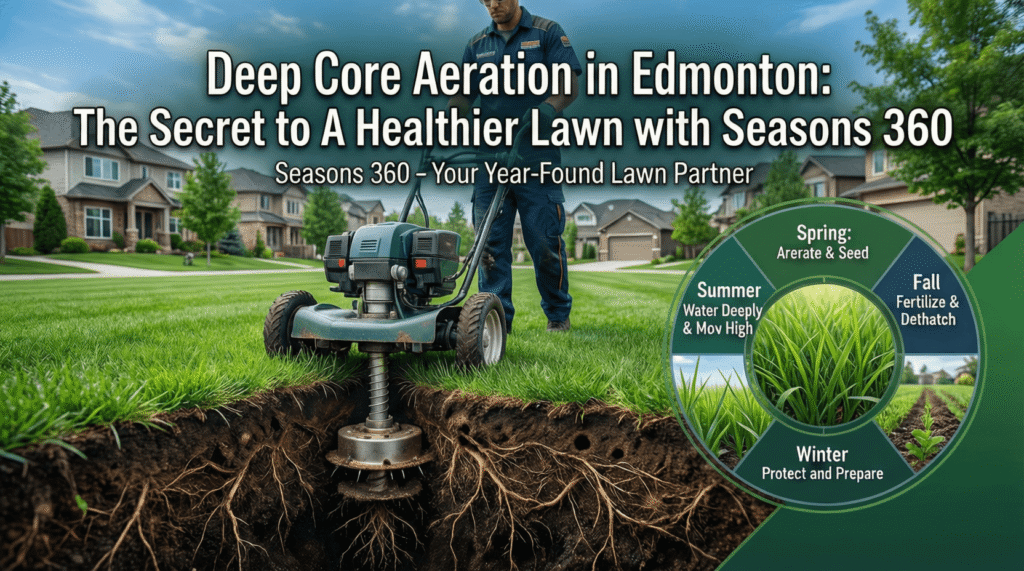
Before addressing frequency, it helps to understand exactly what deep core aeration does and why it matters so much for Edmonton lawns specifically. Aeration is the process of mechanically removing small cylindrical plugs of soil from the lawn — typically three to four inches deep — at regular intervals across the entire surface.
These plugs create open channels through the compacted soil layer that allow three things to happen that could not happen before. Water penetrates directly to the root zone instead of pooling on the surface and running off. Fertilizer and other treatments reach the roots directly rather than washing away before being absorbed. And oxygen enters the soil so that root systems can breathe, grow deeper, and access more of the nutrients and moisture already present in the ground.
For Edmonton’s clay-heavy soil, which compacts naturally under foot traffic, freeze-thaw pressure, and the weight of snow and ice over winter, these channels close back up within a few months as the soil settles. This is why aeration needs to be repeated — once opened, the soil will eventually compact again and the channels close.
Why Edmonton Lawns Need Aeration More Than Most
Not every lawn in every climate needs aeration at the same frequency. Sandy soil, for example, does not compact as severely as clay and may only need aeration every two to three years in mild climates. But Edmonton is not a mild climate, and Edmonton’s soil is not sandy.
The combination of heavy clay soil and Edmonton’s extreme winter freeze-thaw cycles creates compaction conditions that are among the most severe of any major Canadian city. Clay particles bind tightly together when compressed, and the repeated expansion and contraction of frozen and thawing ground works the soil into an increasingly dense structure over successive winters. By the time spring arrives each year, most Edmonton lawns are sitting on soil that is significantly more compacted than it was at the end of the previous summer.
This is not something that resolves on its own. Without regular aeration, compaction accumulates year over year and the lawn gradually becomes thinner, more prone to drought stress, and more difficult to fertilize effectively — because treatments applied to compacted soil simply cannot reach the root zone where they are needed.
How Often Should You Aerate? The Edmonton Answer
Once Per Year — For Most Edmonton Residential Lawns
For the majority of Edmonton residential lawns, annual spring aeration is the right frequency. Done every spring as soon as the soil has thawed and is firm enough to work — typically late April to early May — annual aeration keeps compaction from accumulating and ensures that fertilization, overseeding, and weed control treatments can all perform at their best throughout the season.
Annual aeration is especially important for lawns that receive regular foot traffic, have a history of compaction, or are fertilized each season. Without aeration, fertilizer applied to a compacted Edmonton lawn delivers a fraction of its potential benefit — which means homeowners are spending money on treatments that cannot fully absorb.
Twice Per Year — For High-Traffic or Heavily Compacted Lawns
Some Edmonton lawns benefit from aeration twice per year — once in spring and again in late summer, typically late August. Lawns that fall into this category include those with high foot traffic from children, pets, or recreational use; properties with particularly severe clay compaction that has built up over multiple seasons without previous aeration; and lawns that are undergoing active recovery from significant winter damage.
A late August aeration also pairs well with fall overseeding and fall fertilization — opening the soil channels just before both treatments are applied maximizes the effectiveness of each. For lawns that have struggled to improve despite regular fertilization and care, twice-yearly aeration often produces a noticeable breakthrough in results.
Every Two to Three Years — For New or Low-Traffic Lawns
Lawns that are relatively new, receive minimal foot traffic, and have been well-maintained with consistent fertilization may be able to extend their aeration cycle to every two years. However, even in these situations, Edmonton’s clay soil and winters make annual aeration the safer and more effective default. The cost of annual aeration is modest relative to the results it enables, and skipping a year on clay soil carries more risk than it does in milder, sandier conditions.
Signs Your Edmonton Lawn Needs Aeration Right Now
Even if you are unsure about your lawn’s aeration history, there are clear physical signs that tell you compaction has become a problem and aeration is overdue.
Water pooling on the surface after rain or irrigation instead of soaking in is one of the most obvious signs of compacted soil. If you notice puddles forming on your lawn even during moderate rainfall, the soil is too dense to absorb water at a normal rate.A second sign is a lawn that feels hard and drum-like underfoot rather than slightly spongy. You can also do a simple screwdriver test — push a standard screwdriver into the lawn. If it resists easily after the first inch or two, compaction is the issue.
A lawn that looks thin and yellow despite regular watering and fertilization is another strong indicator. When treatments cannot penetrate the soil, the grass responds with exactly the kind of pale, sparse, struggling growth that homeowners often mistakenly attribute to disease or poor seed. In most cases on Edmonton properties, the answer is compaction — and aeration resolves it.
Spring vs. Fall Aeration: Which Is Better for Edmonton?
Both spring and fall aeration are effective for Edmonton lawns. Spring aeration has the advantage of timing — it opens the soil at exactly the point when fertilization, weed control, and overseeding treatments are being applied, maximizing the performance of every subsequent treatment through the season. Most Seasons 360 clients who do a single annual aeration choose spring for this reason.
Fall aeration in late August or early September works particularly well for lawns that have been heavily used through summer and have compacted again since spring. It opens the soil before fall fertilization and, if overseeding is planned, gives new seedlings the best possible soil contact for germination before Edmonton’s first frost arrives. For lawns doing twice-yearly aeration, spring and late August is the optimal pairing.
Book Your Edmonton Lawn Aeration with Seasons 360
Deep core aeration is one of the most impactful investments you can make in your Edmonton lawn’s long-term health — and it is a treatment where professional equipment genuinely makes a measurable difference. Seasons 360 Ltd. uses commercial-grade aerators that penetrate significantly deeper than rental equipment, delivering the kind of results that actually change how a lawn performs through the full season.
Whether your lawn is due for its annual spring aeration, showing signs of heavy compaction, or you are not sure when it was last done, contact Seasons 360 today for a free quote. We service residential and commercial properties across Edmonton and will make sure your aeration happens at exactly the right time for maximum results.