One of the most common reasons Edmonton lawns struggle year after year is not a lack of effort — it is a lack of timing. Homeowners water, fertilize, and mow, but when those tasks happen at the wrong time of year, the results are always disappointing. Edmonton’s climate does not forgive guesswork. With a growing season that runs roughly from late April to mid-September, every week counts and every treatment has an optimal window.
At Seasons 360, we have maintained lawns across Edmonton through every season and every weather pattern Alberta can throw at a property. Over the years, we have built a clear picture of what needs to happen, when it needs to happen, and why the sequence matters just as much as the individual treatments.
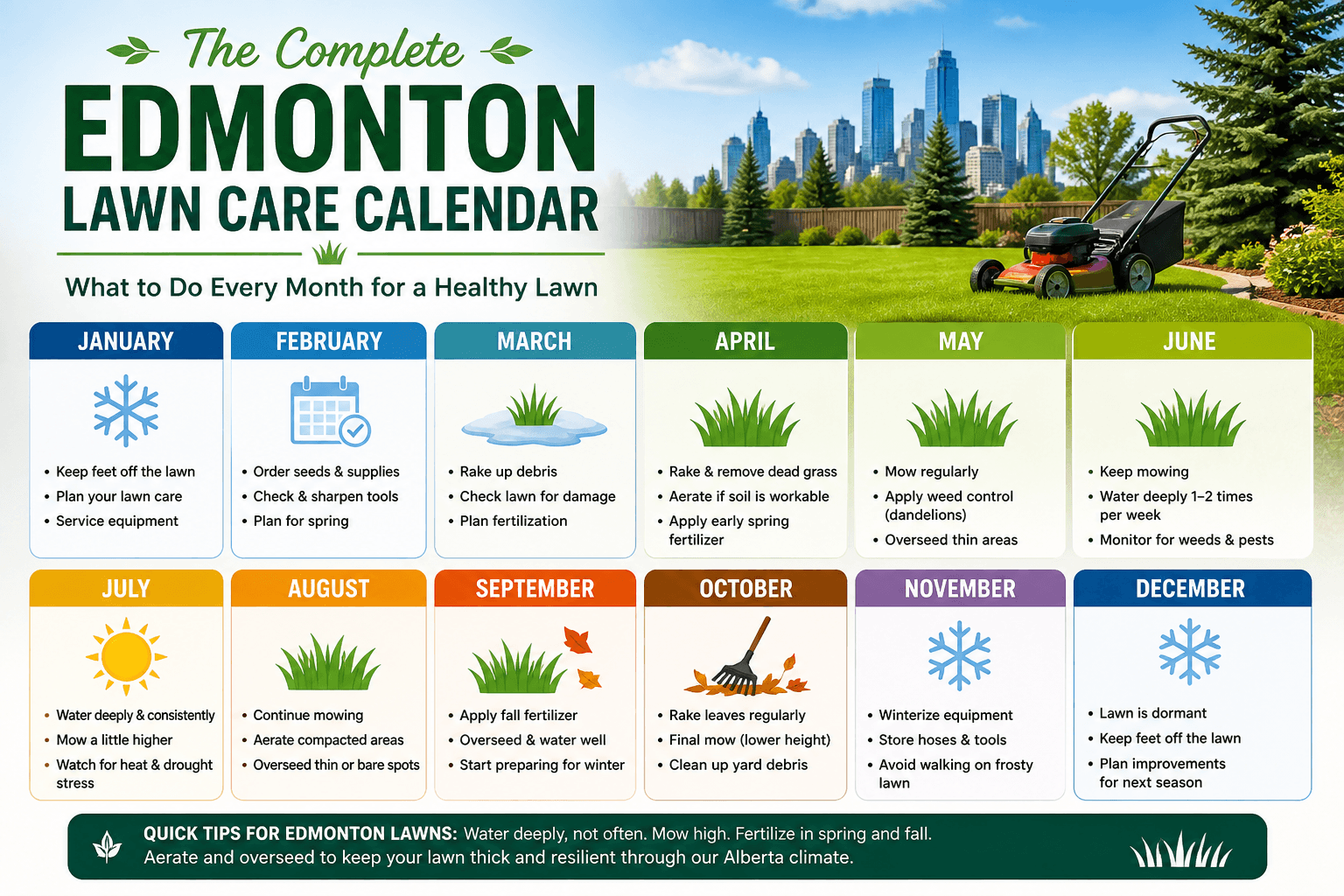
This month-by-month lawn care calendar is built specifically for Edmonton’s climate, soil conditions, and growing season. Whether you manage your own lawn or work with a professional service, this guide gives you a clear roadmap from spring thaw all the way through to the end of the growing season.
April: Wake Up the Lawn the Right Way
April is the most important month in Edmonton’s lawn care calendar, and it is also the one where the most mistakes happen. The temptation to get outside and start working the moment you see bare ground is understandable — but acting too early can damage a lawn that is still in recovery mode.
Spring Cleanup (Late April)
Once the soil has thawed and is firm enough to walk on without leaving deep imprints, spring cleanup is your first priority. This means removing all debris, dead leaves, branches, and the salt and sand deposits that accumulate along driveways and walkways through winter. Leaving this material on the lawn blocks sunlight and traps moisture at the surface, creating conditions that promote disease and prevent the grass from breathing.
Power Raking (Late April)
Immediately after cleanup, power raking should follow. Edmonton lawns accumulate a significant thatch layer over winter — the dense mat of dead grass and organic material that builds up just above the soil surface. When this layer exceeds half an inch, it blocks water, fertilizer, and oxygen from reaching the roots. Power raking removes it aggressively and quickly, giving the lawn room to push up new growth. Most lawns show a visible improvement in colour and density within one to two weeks of a proper power rake treatment.
May: The Most Productive Month for Lawn Recovery
May is where the real recovery work happens. The soil has warmed enough for treatments to take effect, the grass is actively pushing out new growth, and there is still enough of the growing season ahead for the lawn to fully establish before summer heat arrives.
Deep Core Aeration (Early to Mid-May)
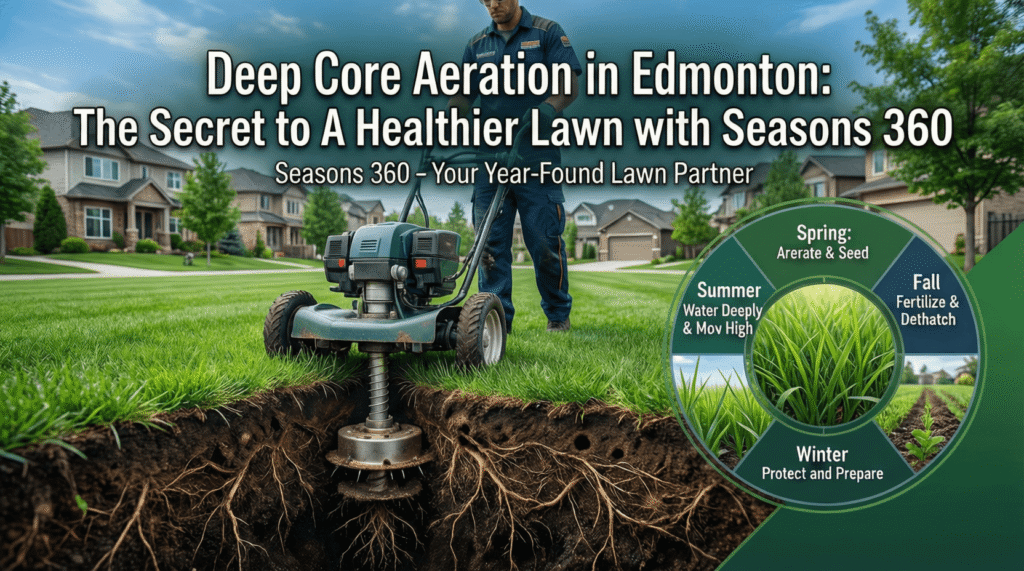
Edmonton’s clay-heavy soil compacts significantly over winter, and compacted soil is one of the biggest obstacles to a healthy lawn. Deep core aeration uses a machine to pull out small plugs of soil across the entire lawn, creating channels that allow air, water, and fertilizer to reach the root zone directly. For Edmonton lawns, this is not an optional treatment — it is essential. Without it, fertilizer sits on the surface and washes away before the roots can absorb it, and grass roots struggle to grow deep enough to withstand summer heat and drought stress.
Lawn Fertilization (Mid-May)
Fertilization should follow aeration within a few days so the nutrients can immediately enter the channels created by the aerator. After a long Edmonton winter, the soil is significantly depleted of nitrogen — the primary nutrient responsible for green colour and blade growth. A slow-release nitrogen fertilizer applied in mid-May feeds the lawn gradually over the following weeks without the risk of burning stressed turf. Applying fertilizer before aeration, or on frozen or waterlogged ground, wastes the product and delivers minimal benefit.
Weed Control (Mid to Late May)
The window for effective weed control opens in mid to late May in Edmonton, just before weeds fully germinate and establish. This timing is critical — applying weed control too early means the product has nothing to target, and applying too late means the weeds are already established and significantly harder to eliminate. A targeted weed control treatment at this stage prevents dandelions, thistle, creeping charlie, and crabgrass from competing with your recovering grass during the most vulnerable part of the growing season.
Overseeding (Late May)
If your lawn has bare or thin patches after the spring treatments, late May is the ideal time to overseed. Spreading new grass seed directly over existing turf — especially after aeration, when the seed can fall into the plugged holes and make direct soil contact — results in significantly better germination rates than seeding on a hard, unprepared surface. New seedlings typically establish within two to three weeks under normal Edmonton spring conditions, provided the area is kept consistently moist during germination.
June: Establish a Mowing Routine and Monitor Progress
By June, your lawn should be actively growing and beginning to show the results of the spring treatments. This is the month where a consistent mowing routine becomes your most important ongoing task.
Lawn Mowing (Ongoing from June)
The most important rule of mowing in Edmonton’s climate is to never cut more than one third of the grass blade in a single session. Cutting too short stresses the lawn, exposes the soil to direct sun which dries it out faster, and creates openings for weeds to establish. For most Edmonton lawns, a mowing height of three to three and a half inches is ideal through spring and early summer. Mow regularly — every five to seven days during active growth — and always with a sharp blade. A dull blade tears the grass rather than cutting it cleanly, leaving the tips brown and the lawn more vulnerable to disease.
June is also a good time to check whether your weed control treatment from May is holding. If new weeds are emerging in isolated areas, a spot treatment can address them before they spread. Keep an eye on any overseeded patches — they should be germinating well by now, but they still need protection from heavy foot traffic and consistent watering.
July: Protect the Lawn Through Summer Heat
July is typically Edmonton’s hottest month, and heat stress is a real concern for lawns that were not properly set up in spring. A lawn that went through proper aeration and fertilization in May will handle summer heat significantly better than one that did not.
Mowing Adjustments for Summer Heat
During the peak heat of July, raise your mowing height slightly — up to three and a half to four inches. Taller grass shades the soil beneath it, reducing moisture evaporation and keeping the root zone cooler. This simple adjustment can make a significant difference in how well your lawn holds up through a hot Alberta summer. If the lawn goes into semi-dormancy during an extended dry spell and growth slows, reduce the frequency of mowing rather than continuing to cut on a fixed schedule.
Mid-Season Fertilization (July)
A light mid-season fertilizer application in early to mid-July helps maintain the colour and density of the lawn through the second half of summer. By this point, the spring fertilizer has been mostly used up by the actively growing grass. A balanced fertilizer applied at a moderate rate — avoiding heavy nitrogen applications in peak heat — keeps the lawn nourished without pushing excessive growth that would stress the turf further.
August: Prepare for the Transition Out of Summer
August marks the beginning of the transition out of peak summer. Temperatures start to ease in the second half of the month, and the lawn often picks up its growth rate again after any mid-summer slowdown. This renewed growth is an opportunity to address any issues that developed over the hot months.
Late Summer Weed Control and Overseeding Assessment
If weeds have persisted or re-established through summer, late August offers a second window for weed control before the season ends. Additionally, this is a good time to assess whether any bare or thin areas need overseeding before the season closes. Late August overseeding gives new seedlings enough time to establish before Edmonton’s first frost, which typically arrives in mid-September. Seeding any later than the first week of September carries significant risk — the seedlings may not be strong enough to survive their first winter.
Second Aeration (Late August — Optional)
For lawns with particularly heavy clay soil or high traffic areas that compact quickly, a second aeration in late August can be beneficial. It opens up the soil again before the fall fertilization that follows in September, improving absorption and giving the roots the best possible conditions to strengthen before winter.
September: The Most Overlooked Month in Edmonton Lawn Care
Most Edmonton homeowners think of September as the end of lawn season. In reality, it is one of the most important months of the entire year — and the treatments done in September directly determine how your lawn survives the winter and how it looks the following spring.
Fall Fertilization (Early to Mid-September)
Fall fertilization is the single most impactful treatment you can do for your Edmonton lawn’s long-term health. A fertilizer with higher potassium content applied in early to mid-September strengthens the grass cell walls, improves winter hardiness, and allows the lawn to store energy in its root system before the ground freezes. Lawns that receive proper fall fertilization consistently come out of winter in better condition, green up faster in spring, and require less recovery work overall. Skipping this step is one of the most common and costly mistakes Edmonton homeowners make.
Final Mowing of the Season (Late September)
Before the season ends, bring your mowing height down slightly for the last one or two cuts of the year — to approximately two and a half to three inches. Grass that is too long going into winter is more susceptible to snow mold, because the long blades mat down under the weight of snow and create the humid, dark conditions that the fungus thrives in. Do not cut too short either — very short grass has less stored energy to draw on through winter. The goal is a clean, moderate height that sets the lawn up well for whatever Edmonton’s winter delivers.
Edmonton Lawn Care Calendar at a Glance
Here is a quick reference summary of the full seasonal lawn care calendar for Edmonton properties:
| Month | Service / Task | Why It Matters |
| April | Spring Cleanup + Power Raking | Clears winter debris and thatch so the lawn can breathe |
| May | Aeration + Fertilization + Weed Control + Overseeding | Core recovery month — the most critical window of the year |
| June | Regular Mowing + Weed Monitoring | Establishes growth routine and catches weed issues early |
| July | Mowing + Mid-Season Fertilization | Protects lawn through peak heat and maintains colour |
| August | Weed Control + Overseeding + Optional Aeration | Addresses summer damage before the season closes |
| September | Fall Fertilization + Final Mowing | Prepares lawn for winter and sets up a strong spring recovery |
Let Seasons 360 Handle Your Lawn Care Calendar in Edmonton
Knowing what to do is one thing — having the time, equipment, and expertise to do it correctly and on schedule is another. Every treatment in this calendar has a narrow window, and missing that window by even a couple of weeks can significantly reduce the results. The sequence matters too. Fertilizing before aerating, or overseeding before weed control, produces far weaker outcomes than following the right order.
At Seasons 360, we manage this entire calendar for our clients across Edmonton. From spring cleanup and power raking in April through to fall fertilization in September, we handle every service at exactly the right time so your lawn looks its best through every month of the growing season. We use professional-grade equipment, proven products, and local expertise built specifically around Edmonton’s climate and soil conditions.
Contact Seasons 360 today for a free quote and let us put together a complete lawn care plan for your Edmonton property — so you never have to guess what your lawn needs or when.